JAST Blue publishes Japanese BL visual novels for an international audience, focusing on quality translation and respect for the original work. By concentrating on mature, character-driven stories that larger publishers often pass over, JAST Blue gives fans reliable access to titles that would otherwise remain unavailable outside Japan. JAST Blue's audience is familiar with visual novels and actively looks for queer stories that are handled thoughtfully rather than simplified or censored. The company's narrow focus and consistent quality make it a trusted publisher within a specific niche.
The tagline "Love beyond boundaries" is designed to reflect JAST Blue's role as both a publisher and a cultural bridge. At a surface level, it refers to the company's core function of bringing Japanese BL visual novels to Western audiences, emphasizing the idea of crossing geographic and linguistic boundaries through localization. However, the tagline also carries deeper, more layered meaning — JAST Blue's catalog frequently explores queer relationships and narratives that exist outside of traditional heteronormative frameworks, so the phrase "beyond boundaries" also speaks to the way these stories challenge social and cultural expectations.
The tone of the tagline is intentionally emotional and slightly open-ended. Rather than being overly descriptive or literal, it creates a sense of intrigue and invites interpretation. This aligns with the nature of visual novels, which rely on emotional engagement and personal connection. At the same time, the wording avoids being overly explicit about darker or more complex themes, allowing the brand to maintain a professional and accessible image while still resonating with its target audience.
This tagline reinforces JAST Blue's positioning as a niche publisher focused on authenticity, representation, and meaningful storytelling. "Love beyond boundaries" captures the company's value proposition in a concise and flexible way, making it suitable for a wide range of marketing contexts while still maintaining a strong connection to its core audience.
JAST Blue is a niche game publisher focused on localizing and distributing Japanese BL (Boys' Love) visual novels to a Western audience. The company serves a dedicated fanbase that values story-driven experiences, character depth, and emotional engagement over mainstream gameplay trends.
Unlike larger publishers that prioritize broad appeal, JAST Blue targets a specific community and builds strong relationships through consistent releases, community awareness, and culturally sensitive localization. Their brand identity is closely tied to authenticity, niche storytelling of mature themes, and representation of queer narratives that are often underserved in global markets.
JAST Blue's brand is defined by its focus on story-heavy visual novels, particularly within the BL and otome-adjacent space. Its titles are known for mature, emotionally intense themes and a strong emphasis on narrative depth rather than traditional gameplay mechanics. Unlike mainstream game publishers that prioritize accessibility and wide appeal, JAST Blue leans into niche specificity, allowing it to deeply resonate with a smaller but highly engaged audience.
- Representation: Strong commitment to representing queer narratives within the gaming industry, prioritizing stories that are often overlooked by mainstream publishers.
- Localization Integrity: Preserving the original storytelling intent during localization while balancing authenticity with accessibility for Western audiences.
- Emotional Storytelling: Emphasizing emotional depth and complex themes over purely commercial viability.
- Community Trust: Long-term fan relationships and active work to bring niche Japanese media to a wider audience.
- Cultural Respect: Respect for cultural nuance in translation and localization; balancing authenticity with accessibility.
JAST Blue's brand culture is deeply rooted in Japanese visual novel traditions while also being closely connected to Western fandom spaces such as Tumblr, Twitter, and niche online communities. The brand fosters an environment that is openly inclusive of LGBTQ+ audiences, which aligns with the themes present in many of its titles.
Unlike larger, profit-driven publishers, JAST Blue presents itself as a passion-driven company, contributing to the perception of it being more of a "community publisher" than a corporate entity. This culture strengthens its relationship with its audience and reinforces its position within a highly engaged and loyal niche market.
JAST Blue's core audience consists of adults aged 18–35 who actively engage with BL (Boys' Love) media, visual novels, and anime-inspired storytelling.
| Factor | Detail |
|---|---|
| Age | 18–35 (primary), with some older niche fans |
| Gender | Mixed, but strongly includes women, LGBTQ+ players, and queer men |
| Location | North America, Western Europe (Germany, France), Brazil, parts of Southeast Asia |
| Language | Primarily English-speaking, but high interest in localized content |
- Values emotional storytelling, character depth, and relationship dynamics
- Interested in queer narratives, especially those not commonly represented in mainstream games
- Comfortable with mature or explicit content when it serves narrative or character development
- Highly engaged in fandom culture (fan art, discussions, shipping, etc.)
- Drawn to aesthetic experiences (music, art style, atmosphere)
- Purchases through platforms like Steam, JAST storefront, or niche marketplaces
- Willing to download patches/mods for full content access
- Actively follows developers/publishers on Twitter/X, Instagram, Reddit, and Discord
- Shares reactions, screenshots, and opinions within fandom communities
- Likely to replay games for different routes and endings
| Motivations | Pain Points |
|---|---|
| Seeking emotional connection and immersion | Confusing patch installation processes |
| Desire for authentic, uncensored storytelling | Censorship or fragmented content across platforms |
| Interest in supporting niche or imported media |
This formula identifies which international markets offer the strongest growth opportunities for JAST Blue. Because JAST Blue publishes Japanese BL visual novels for a niche audience, the best growth markets are not simply the largest countries, but the countries where there is already evidence of interest in visual novels, BL content, and localized Japanese media.
- A — Current market interest score (website traffic, wishlist activity, social media engagement)
- B — Visual novel / BL audience size score (estimated size of relevant niche audience)
- C — Conversion potential score (purchase conversion rates or cart activity)
- D — Execution readiness score (payment access, platform support, localization feasibility)
- E — Competitive saturation score (strength of competitors in that market)
- F — Localization difficulty / market barrier score (language complexity, support burden, legal or platform barriers)
Poor candidates for growth investment. Low existing interest, weak conversion, high competition, or strong barriers.
Best candidates for a growth campaign. Some audience interest and market fit exist, but adoption is not yet maximized.
Strong traction and brand awareness. Better suited for retention, loyalty, preorder, or premium launch campaigns.
- Germany — Likely ideal growth range: strong anime/visual novel interest with manageable localization requirements.
- Brazil — High interest and community engagement, but slightly lower execution readiness due to payment systems, pricing sensitivity, and localization costs.
- South Korea — Competitive local game industry and different content preferences may lower overall score despite a large gaming audience.
Executive Summary: This report evaluates whether JAST Blue should add support for the Hausa language. While Hausa represents a large and growing language market with increasing internet access, it does not currently align strongly with JAST Blue's niche audience or product type. Based on both qualitative and quantitative analysis, the recommendation is not to prioritize Hausa localization at this time.
- User Demand: Limited visible overlap between Hausa-speaking markets and BL visual novel niche communities (anime/manga fandom, Japanese media consumption, established VN communities).
- Cultural Relevance: BL content themes may not align with cultural norms in many Hausa-speaking regions; media regulations and LGBTQ+ acceptance can limit accessibility and audience reach.
- Language Visibility Online: Hausa is widely spoken (especially in Nigeria and Niger), but much online content remains in English or French, and many users are bilingual, reducing the immediate necessity of Hausa localization.
- Business Strategy Alignment: Entering a market with low existing demand would require significant investment in audience education, not just translation, reducing the likelihood of immediate ROI.
- Hausa is spoken by an estimated 70–80 million native speakers, with over 100 million total speakers.
- Nigeria has over 100 million internet users, but access is concentrated in urban, English-speaking populations.
- The potential user base for visual novels within Hausa-speaking regions is currently limited due to low genre awareness, limited platform access, and lower purchasing power compared to core markets.
- Very few game publishers localize into Hausa; major visual novel publishers do not currently support it.
JAST Blue should not prioritize Hausa localization at this time. Instead, JAST Blue should monitor growth in internet usage and anime/visual novel communities in these regions, consider indirect market entry through English-language support first, and revisit Hausa localization if demand signals increase.
Tier 3 — Monitor Only Track website traffic and user engagement from Hausa-speaking regions, monitor social media and community growth, and evaluate demand signals over time before committing resources.
Platform: Instagram
Increase brand awareness and engagement among BL/visual novel audiences, while building a recognizable aesthetic identity. Instagram is highly visual, which aligns with JAST Blue's stylized, emotionally driven content. It allows for strong aesthetic branding, short-form storytelling, and community interaction through comments and shares. Focusing on one platform also prevents content burnout and keeps strategy consistent.
- Voice: Minimalist, poetic, suggestive rather than explicit
- Tone: Intimate, slightly unsettling, emotionally intense
- Avoid: Overly corporate or promotional language
Example captions: "Some feelings don't fade." | "You weren't supposed to look that closely."
Frequency: 4 posts per week
Content Types: Stylized visuals, character-focused posts, short quotes/dialogue, glitch/weirdcore aesthetic edits, fan engagement posts (polls, opinion-based questions, comment prompts)
Content Pillars:
- Emotional tension (relationships, intimacy)
- Aesthetic visuals (art, edits)
- Narrative intrigue (cryptic storytelling)
| What's Working | What's Not Working | Adjustments |
|---|---|---|
| Visual-first posts | Over-explaining | Increase visual-heavy posts to 70% |
| Emotional / ambiguous captions | Traditional marketing language | Reduce caption length |
| Add more "interpretive" content to allow audience engagement | ||
| Use carousel posts to show progression and build tension |
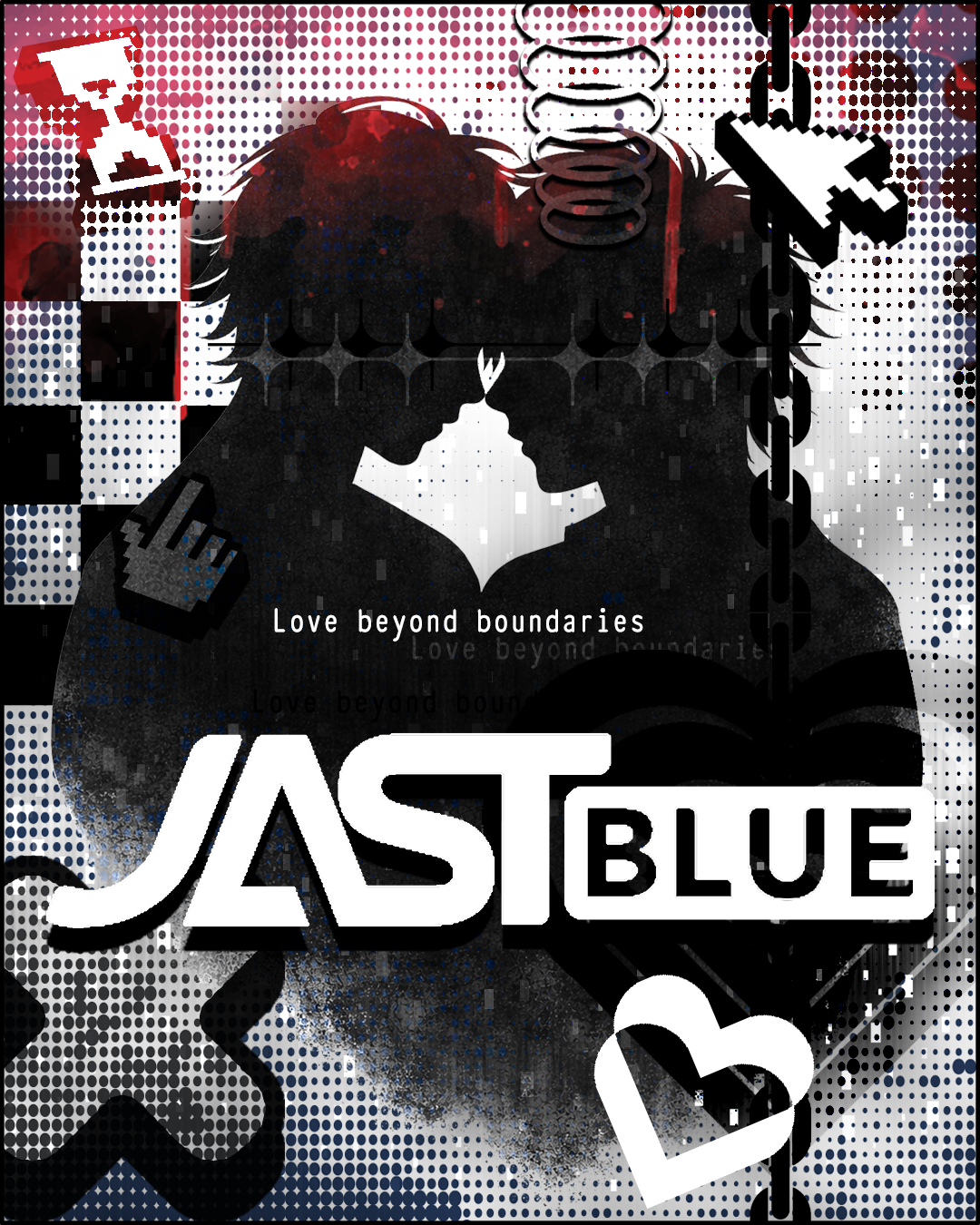
For this project, the primary focus was on sight and touch as the primary sensory elements, since these are central to how JAST Blue's stories create emotional impact. Many of their titles build tension through visual framing and physical proximity, so the imagery reflects that dynamic rather than depicting anything explicitly.
The silhouettes represent touch through closeness and implied intimacy. While there is minimal physical contact, the tension between the figures suggests a strong emotional connection. The abstract heart monitor line running between their sightlines reinforces this connection through vision, while also visually aligning with the point where their foreheads nearly meet, bridging sight and touch.
Sight is further emphasized through glitch effects, halftone textures, and pixel elements, creating a layered and slightly disorienting experience. The goal is to create intrigue and controlled discomfort, making the image memorable while reinforcing JAST Blue's darker tone.
Increase repeat purchases and long-term engagement by introducing customers to additional visual novels, community resources, and limited promotions over a six-month period.
Customer recently purchased their first JAST Blue visual novel but has not purchased additional titles. They may be new to BL visual novels and may not yet be familiar with the publisher's catalog or community.
| Days After Purchase | Purpose | Email Content Summary |
|---|---|---|
| 7 Days | Initial engagement and onboarding | Welcome email thanking the customer for their purchase. Includes links to installation guides, community forums, and support resources. Introduces JAST Blue and encourages players to explore the story and characters. |
| 14 Days | Encourage engagement with the game | Email highlighting character profiles, soundtrack previews, or bonus content related to the game they purchased. Encourages the player to continue their playthrough and share thoughts with the community. |
| 30 Days | Cross-sell similar titles | Recommend other BL visual novels similar in theme or tone to the game they purchased. Include a small promotion (e.g., 10% off another title). |
| 60 Days | Community engagement | Invite the player to participate in the fan community, read developer interviews, or join discussions about favorite characters and storylines. Highlight fan content and community spaces. |
| 120 Days | Promotion / seasonal sale | Inform customers about a seasonal sale or limited-time promotion on select visual novels. Encourage customers to expand their collection or purchase titles as gifts. |
| 180 Days | Loyalty / review request | Ask the customer to review the game they purchased and share feedback. Offer a small incentive (e.g., discount code) for their next purchase. Reinforces loyalty and gathers user feedback. |
Note: Some CRM emails involving promotions or discounts may need to be localized differently depending on the region. Pricing, sales timing, and promotional campaigns often vary between markets. Promotional emails should be carefully reviewed before localization to ensure the message and offer are relevant to each target region.
This language tiering system uses the Growth Opportunity Score (GOS) to prioritize localization efforts across international markets. Language prioritization is based not only on total population size, but on audience fit, existing demand, and the company's ability to execute in each market.
GOS: 80–100
Very strong existing demand for BL / visual novels, high conversion rates and repeat purchases, strong execution readiness, and manageable competition. Primary focus for growth and revenue with full localization investment across all content types.
- Simplified Chinese
- Traditional Chinese
- Korean
GOS: 60–79
Moderate to strong audience interest, growing fandom presence, reasonable conversion potential, and some localization or cultural barriers. Best return on investment for growth campaigns; expand into markets with proven but not fully developed demand.
- Spanish
- Portuguese (Brazil)
- German
- French
GOS: Below 60
Low or uncertain audience overlap, limited conversion potential, and high localization or cultural barriers. Monitor market trends and avoid heavy investment until demand increases.
- Hausa
- Arabic
- Hindi
| Tier | Unlimited Resources | Limited Resources |
|---|---|---|
| Tier 1 | Full investment | Full investment |
| Tier 2 | Full or near-full support | Selective / partial support |
| Tier 3 | Experimental expansion | No active support |
Lamento: Beyond the Void – Definitive Edition is a fully localized English release of Nitro+Chiral's dark fantasy BL visual novel. This edition includes updated UI, improved translation quality, and integrated Help Center support to guide new players through gameplay mechanics and story navigation. The product targets Western BL and visual novel audiences who value emotionally intense storytelling, mature themes, and high-quality localization.
| Phase | Task | Marketing | Localization | Notes |
|---|---|---|---|---|
| Idea | Select title for localization (Lamento) | — | — | Internal decision |
| Research | Audience analysis (BL market, VN fans) | ✓ | — | Identify target audience |
| Research | Competitive analysis | ✓ | — | Steam, MangaGamer, etc. |
| Design | UI/UX review for English expansion | — | ✓ | Text expansion, font issues |
| Design | Product naming validation | ✓ | — | Check cultural fit |
| Development | Game build + engineering updates | — | — | Core dev work |
| Pre-Launch | Trailer, website, store page | ✓ | ✓ | Localization of assets |
| Pre-Launch | Help Center content (FAQs, guides) | — | ✓ | Critical for onboarding |
| Testing | QA (English build) | — | ✓ | LQA + bug reporting |
| Testing | Marketing asset testing | ✓ | ✓ | Messaging consistency |
| Localization | Full game localization | — | ✓ | Translation + editing |
| Localization | LQA + bug fixing | — | ✓ | Final polish |
| Launch Day | Social media, trailers, ads | ✓ | ✓ | Localized campaigns |
| Launch Day | Help Center live updates | — | ✓ | Real-time fixes |
| Post-Launch | Community engagement | ✓ | — | Reviews, feedback |
| Post-Launch | Help Center updates | — | ✓ | Iteration + fixes |
During the design phase, localization ensures the product is technically and culturally adaptable — including text expansion, UI limitations, and cultural appropriateness. Failing to include localization early often results in rushed work and delayed launches. During pre-launch and testing, all marketing assets, UI text, and Help Center content must be translated and reviewed for accuracy and tone consistency. Post-launch, localization continues to support updates, bug fixes, and Help Center improvements.
Marketing helps define the target audience and positioning strategy during research. Pre-launch and testing: creates promotional assets such as trailers, social media campaigns, and storefront descriptions, aligned with the product's tone and messaging. At launch, drives visibility through campaigns and announcements while monitoring user engagement. Post-launch: focuses on community interaction, reviews, and long-term brand engagement.
An email announcing a new feature was mistakenly sent to customers before the feature is ready. Because the email included a link to download or access the feature, users may attempt to use something that is not yet functional. Immediate coordination across multiple teams is required to minimize confusion and maintain customer trust.
1. Pause Access to the Feature
The Product and Engineering teams should immediately disable or redirect the feature link included in the email so customers cannot attempt to use an unfinished feature. If possible, the link should temporarily redirect to a message explaining that the feature will be available soon.
2. Coordinate Internal Teams
- Marketing / CRM Team: Pause any scheduled emails related to the feature; draft a follow-up clarification email to customers.
- Product & Engineering: Disable or redirect the feature link; provide an updated timeline for when the feature will actually be ready.
- Customer Support: Prepare canned responses for incoming questions; update Help Center articles explaining that the feature is not yet available.
- Community / Social Media Team: Monitor community channels for complaints; provide consistent messaging if users ask about the feature.
A follow-up email should be sent to customers explaining that the feature was announced earlier than intended and will be available soon. This message should reassure customers that the feature is still planned and provide an approximate timeline if possible. Transparency is important to maintain trust and mitigate frustration.
- The accidental email may have been localized into multiple languages, meaning the clarification email must also be localized quickly.
- Customer support teams in different regions will need localized canned responses to address questions.
- Help Center updates and support documentation may need to be translated so that all customers receive consistent information.
Localization teams should be informed immediately so they can prioritize translating the clarification email and support materials.
After resolving the immediate issue, the company should review its internal communication and approval processes for CRM campaigns to prevent similar mistakes in the future. This may include additional approval checkpoints before emails are sent to customers.
JAST Blue operates in a niche market focused on localizing Japanese visual novels with mature and complex themes. Due to platform restrictions, cultural differences, and technical delivery challenges, the company must be prepared to respond quickly and effectively to potential crises. This section outlines key risks and a flexible response strategy to manage them.
JAST Blue may face backlash when platform policies (e.g., Steam guidelines) require modification or removal of explicit content. For example, titles such as DRAMAtical Murder and Sweet Pool required external patches to restore full content. These changes can lead to accusations of censorship, even when they are necessary for platform compliance.
Some releases rely on external patches to restore full content. If users encounter difficulty installing these patches due to unclear instructions or technical issues, it can result in frustration, negative reviews, and increased support requests. This may create the perception of an incomplete or broken product.
Platform content policies are not always applied consistently. Games with similar levels of explicit content may be treated differently depending on context, themes, or perceived risk. This can lead to confusion and amplify user backlash, even when no legal violation has occurred.
These risks are predictable to some extent, particularly during major releases or when known platform limitations are involved. Without clear communication, they may result in confusion, misinformation, and loss of customer trust.
Bring together Legal, Marketing, Support, Localization, and Product to coordinate the response.
Determine whether the crisis stems from a platform restriction, a technical issue, or a user perception problem.
Document confirmed facts clearly before any external communication is made.
Acknowledge the issue to the public in a calm, transparent, and non-speculative manner.
| Team | Responsibilities During Crisis |
|---|---|
| Legal | Ensures compliance and approves all external messaging before publication. |
| Marketing | Develops public-facing communication and manages tone across all channels. |
| Support | Handles customer inquiries and escalations; prepares canned responses. |
| Localization | Adapts messaging across languages and regions on accelerated timelines. |
| Product / Engineering | Investigates and resolves technical issues; provides status updates to other teams. |
- Maintain a clear, calm, and transparent tone in all communications.
- Acknowledge user concerns without assigning blame to any party.
- Avoid speculation or sharing unverified claims publicly.
- Ensure messaging consistency across all platforms and languages.
- Social media (Instagram, Twitter/X) for immediate updates
- Official website announcements
- Help Center and FAQ pages
- Email communication (if directly impacting customers)
| Type | Includes | Purpose |
|---|---|---|
| Proactive | Pre-written explanations of platform restrictions; patch installation guides; FAQs addressing expected concerns | Reduces confusion and enables more controlled, consistent messaging before issues escalate |
| Reactive | Responses to user backlash or confusion after release; updates as new information becomes available | Ensures timely response when unexpected issues arise |
First public acknowledgment of the issue, approved by Legal and drafted by Marketing.
Full FAQ and Help Center updates published with technical guides and troubleshooting resources.
Priority market translations delivered for all crisis communications and customer-facing assets.
- Statement templates for common crisis scenarios
- FAQ frameworks covering platform restrictions and patch issues
- Technical guides (e.g., patch installation steps)
To ensure efficient localization during crisis situations, JAST Blue will implement predefined vendor support levels. Emergency support will be used selectively due to cost and efficiency considerations — proactive planning should reduce the need for continuous high-level support.
Standard business hours. Used for routine localization tasks with no urgent deadline pressures.
Includes weekend coverage. Activated when a crisis requires faster turnaround but is not yet critical.
Limited 24/7 support for critical situations. Reserved for high-impact crises requiring immediate localized output.
Localization plays a critical role in ensuring that crisis communication is accurate, clear, and culturally appropriate across all markets. Localization teams are expected to operate on accelerated timelines during crises while maintaining accuracy and consistency.
- Translation and Adaptation: Translate and adapt official statements and FAQs promptly for all active markets.
- Terminology Clarity: Ensure legal and technical terminology is rendered accurately and clearly in each target language.
- Tone Adjustment: Adjust tone and register based on regional expectations and cultural norms.
- Escalation Prevention: Prevent further crisis escalation caused by mistranslation, ambiguity, or culturally inappropriate messaging.